Bioburden Testing
Bioburden testing quantifies the microbial population on a medical device before sterilization. Boulder BioLabs executes bioburden testing protocols aligned with ISO 11737-1, operating under the Boulder BioMed ISO 13485 quality management system. The data feeds directly into the cycle development and routine monitoring programs at Boulder Sterilization next door.
What Is Bioburden Testing?
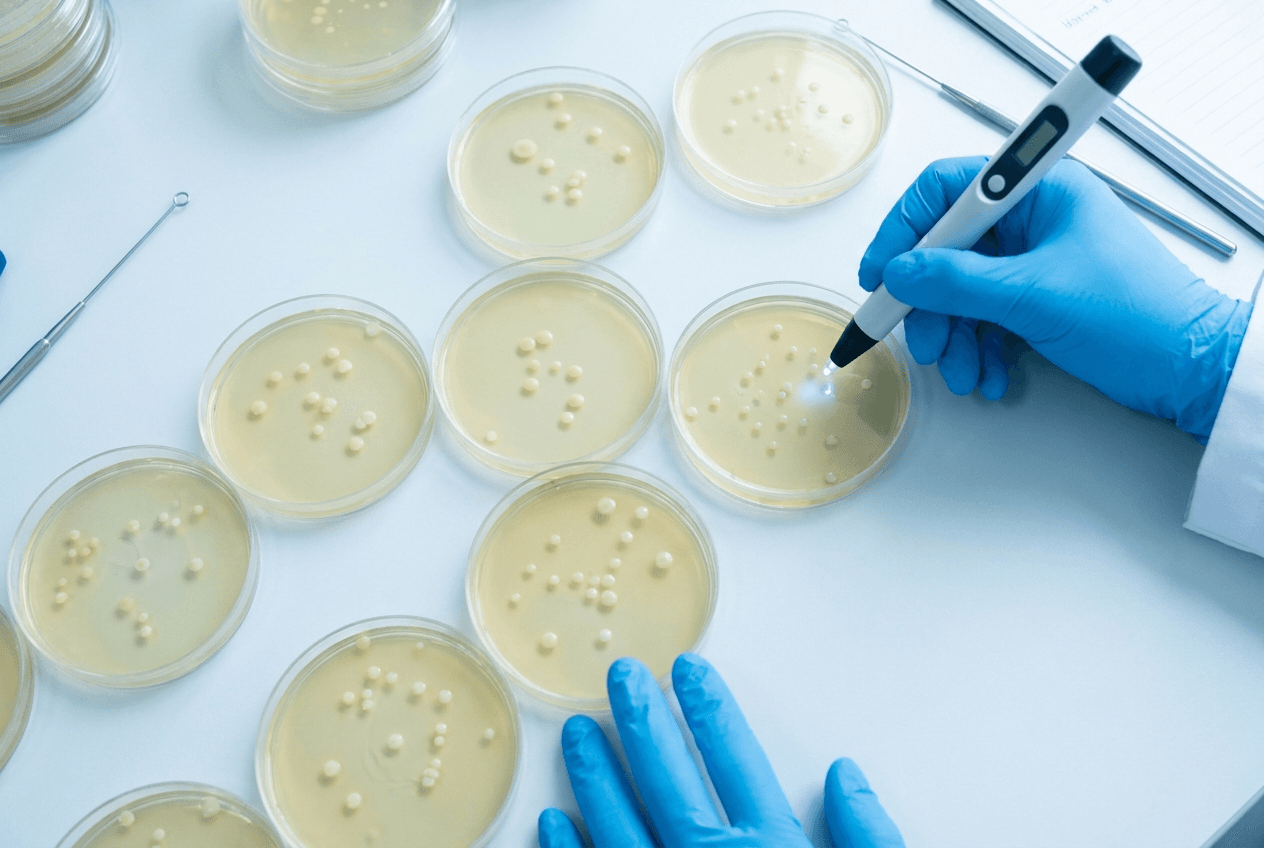
Bioburden testing recovers viable microorganisms from a device using a validated extraction technique — rinse, sonication, or destructive methods — and enumerates by membrane filtration or pour-plate. Results are reported in CFU per device with aerobic/anaerobic/fungal breakouts, adjusted by a validated recovery efficiency (RE) factor.
For sterilization programs, bioburden is the input to the validation math — EO half-cycle calculations, radiation dose-setting (VDmax, Method 1/2), and CD cycle parameters all start from a bioburden number.
When You Need It
- EO sterilization programs — initial validation, quarterly monitoring, routine release.
- CD sterilization programs — bioburden establishes the load entering CD cycles.
- Radiation sterilization — bioburden data for VDmax 25, Method 1, dose-audit programs.
- Method validation and recovery efficiency studies.
- New product introduction.
Our Process
- Sample receipt per the validated sampling plan.
- Extraction — rinse, sonication, stomacher, or destructive.
- Recovery and enumeration — membrane filtration or pour-plate.
- Incubation — aerobic, anaerobic, and fungal per ISO 11737-1 protocols.
- RE factor application.
- Reporting with raw counts, RE, adjusted estimate, and genus-level ID on request.
Why Boulder BioLabs for Bioburden
Co-locating bioburden testing with Boulder Sterilization tightens the feedback loop. When bioburden trends up, sterilization cycle parameters can be tuned before the next production lot is loaded.